
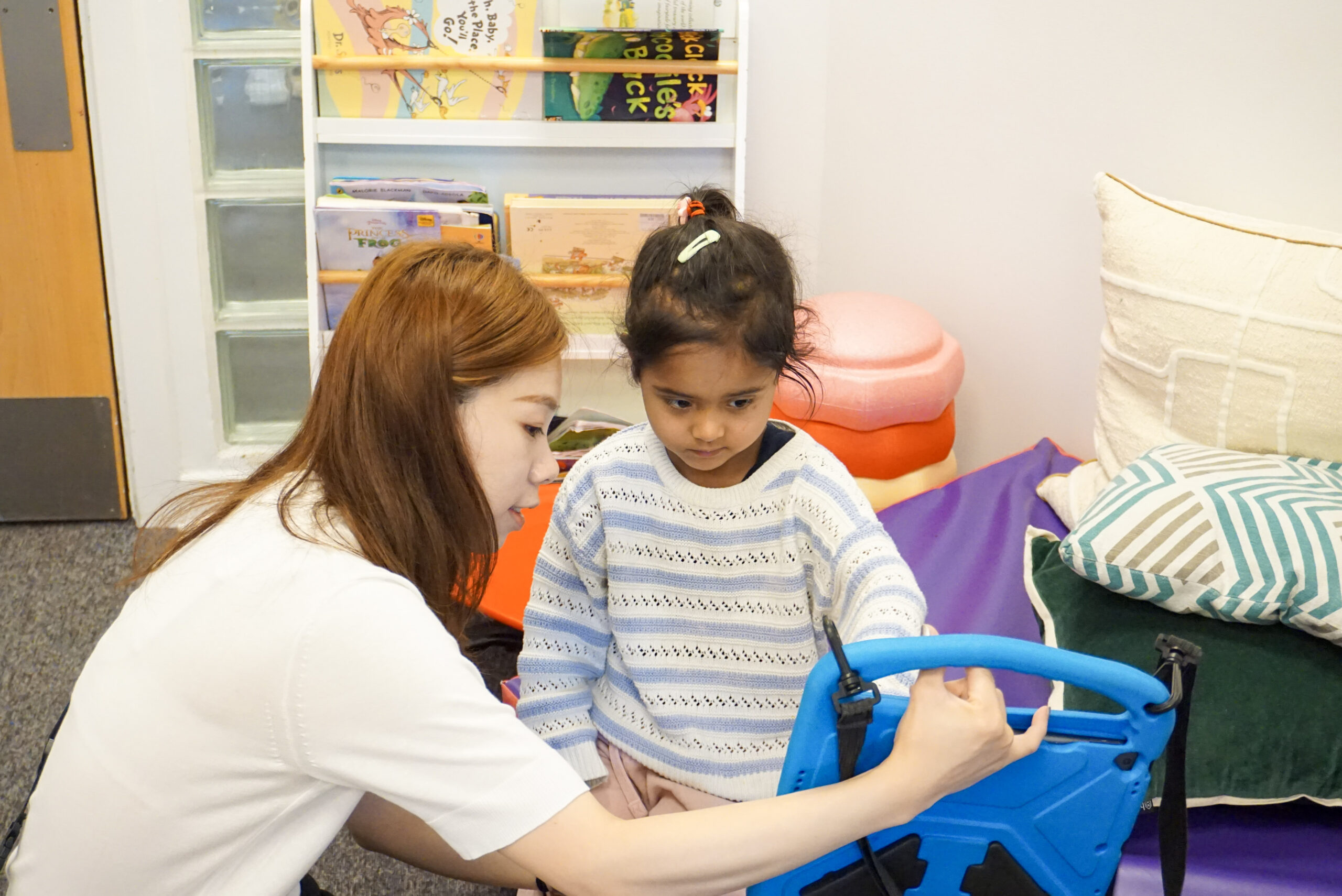
When a child is struggling to communicate, daily life can feel unpredictable for the whole family. You might notice your child becoming frustrated when they cannot express what they need, or you may be unsure how to support their development in a way that feels effective and kind. It can be hard to know what to try first, or how different approaches fit together.
At First Bridge Education, we hear this concern from many parents of children aged 2 to 9, and it is exactly why our upcoming free webinar focuses on how Applied Behaviour Analysis (ABA) and Augmentative and Alternative Communication (AAC) work hand in hand.
Communication looks different for every child, and there is no single path. What matters is finding an approach that builds confidence, reduces frustration, and opens up more opportunities for connection. ABA and AAC can work together to support this journey, giving children structure, encouragement and practical tools that match their developmental stage.
What do ABA and AAC actually mean for your child?
Parents often ask what ABA really involves. At its core, ABA is a carefully structured, evidence-based approach that helps children develop skills step by step. It focuses on understanding behaviour, teaching new skills through positive reinforcement, and breaking larger goals into achievable parts. In practice, that might look like teaching a child to request items, take turns, follow routines, or engage with peers in ways that feel manageable for them.
AAC refers to any method of supporting communication beyond speech. This can include picture cards, gesture systems, communication boards, and tools like PECS or speech-generating devices. AAC does not replace speech. It reduces pressure and gives children a reliable way to communicate while verbal skills are still developing.
Parents sometimes worry that AAC may hold their child back from speaking, but, evidence shows that it often increases children’s attempts to communicate and can help speech develop more naturally. AAC provides an immediate pathway to connection, which is vital during early intervention.
How do ABA and AAC work together?
ABA and AAC complement each other. ABA provides a structured teaching framework that supports children to understand, practise and use communication skills consistently. AAC gives children the actual tools and language systems they can rely on in the moment. When combined, children can communicate more clearly across environments such as home, nursery, school and community settings.
Within our programmes at First Bridge Education, we often introduce AAC alongside ABA to support things like requesting, labelling, making choices, or expressing needs. The familiarity and predictability of ABA teaching methods help children understand how to use AAC systems effectively. Over time, they become more confident communicators in a way that reduces frustration and builds independence.
What does this look like in a typical school day?
Parents often want to picture what this approach looks like in everyday life. At First Bridge Education, children experience communication support woven through their whole day, not added on top of it. For example:
- During snack time, a child may use picture symbols to request their preferred food while a practitioner models verbal language alongside it.
- In play sessions, a child might use a communication board to take turns or ask for help, supported by an adult who uses gentle prompts based on ABA principles.
- During structured learning time, your child’s team may use ABA strategies to teach new vocabulary or concepts, reinforced through AAC tools that stay consistent throughout the week.
This combination provides children with clarity and stability, which is especially important for children with autism, global developmental delay or early speech and language challenges. It also helps parents see how communication strategies can be used at home without feeling overwhelming or confusing.
Why is early communication support so important?
Between the ages of 2 and 9, children’s brains are developing rapidly, and communication skills form the foundation of learning, relationships and independence. When a child has the support they need during the early years, they are more likely to develop communication patterns that help them understand others and feel understood themselves.
Many families join us after trying other approaches that did not quite fit, or after feeling unsure how to move forward. Early intervention offers families clarity and direction, and it gives children the best possible chance to thrive. Every child deserves a communication system that supports them in a way that feels natural and respectful.
How does First Bridge Education provide this support?
First Bridge Education is more than an ABA school. We are a specialised early years and primary setting that integrates ABA, speech and language strategies, occupational therapy-informed practice and AAC support within a warm, safe and consistent environment.
Parents often tell us that what makes the difference is the level of expertise within our team. Our practitioners, behaviour analysts, and communication specialists are highly trained in both ABA and AAC implementation. This depth of knowledge helps us tailor each child’s programme with precision while ensuring the approach remains caring and child centred.
Every child who joins First Bridge receives a personalised communication plan. This is shaped by observations, family input, and a Suitability Assessment that helps us understand exactly what your child needs. These assessments are not diagnostic. They help us figure out how best to support your child and whether our environment is the right place for them.
Your child’s progress is tracked through regular reviews so we can adapt their communication strategies as they grow. For many families, this consistency brings relief and reassurance, especially when communication has previously felt uncertain or unpredictable.
What benefits can families expect?
Parents often notice a shift quite quickly once their child has a communication system that makes sense to them. These changes can include:
- Lower frustration levels as children gain reliable ways to express themselves
- Improved understanding of daily routines and expectations
- Increased willingness to interact with adults and peers
- More spontaneous communication attempts, even outside structured sessions
- A calmer home environment as parents gain clear strategies to support communication
Families also tell us they appreciate knowing they are not navigating this alone. By partnering with the First Bridge team, parents have someone to ask questions, share concerns and celebrate progress with.
What will the webinar cover?
Our upcoming free webinar, Building Communication: How ABA and AAC Work Together, provides a gentle introduction to how these approaches support young children’s communication development. During the session, you will learn:
- What ABA looks like in early childhood settings
- How AAC tools can be introduced in safe, supportive ways
- Practical examples from our nursery and school
- How highly trained First Bridge practitioners use ABA and AAC together
- What to consider when deciding your child’s next communication steps
Our webinar is led by specialists who use ABA and AAC every day in our classrooms. They bring years of experience and understand the questions and worries many parents carry when exploring different approaches for the first time. The session gives you space to pause, understand the essentials, and hear directly from experts who work closely with children aged 2 to 9 in an ABA and AAC integrated environment.
How to join the webinar
If you are currently exploring support for your child’s communication, or you are curious about how ABA and AAC complement each other, we would love to welcome you. The session is free to attend, and families are welcome to join regardless of where they are in their decision-making journey. You can sign up through our Eventbrite page.
Supporting a child’s communication can feel daunting, but you do not need to work it out alone. Our team is ready to help you understand your options and feel confident about the next steps for your family.